Falls Church Mixed Use Investment Guide Explained
May 28, 2026
May 28, 2026
If you have looked at Falls Church and thought, "Could a small mixed-use building actually work here?" the short answer is yes, but only with a clear understanding of how this compact city operates. For many buyers and investors, the appeal is obvious: strong household incomes, transit access, and an active redevelopment pipeline create a market where neighborhood-serving retail and upper-floor housing can make sense together. This guide walks you through what small mixed-use investments in Falls Church usually look like, what drives demand, and where the real risks tend to show up. Let’s dive in.
Falls Church is a very small city with an outsized profile. The city describes itself as just 2.2 square miles with more than 14,000 residents, located inside the Capital Beltway and close to Washington, DC, Tysons, and the Rosslyn-Ballston corridor.
That location matters because access helps support both residential demand and neighborhood retail activity. The city is also near the East Falls Church and West Falls Church Metrorail stations, with bus and bikeshare options adding to mobility.
The local numbers help explain the appeal. Census QuickFacts show a 2024 population estimate of 15,034, median household income of $143,262, median gross rent of $2,190, median owner-occupied home value of $1,055,600, and retail sales per capita of $48,577.
For a small mixed-use investor, those figures point to a market that can support compact, higher-value real estate. They also suggest that the strongest fit is often housing above with practical, everyday retail at street level.
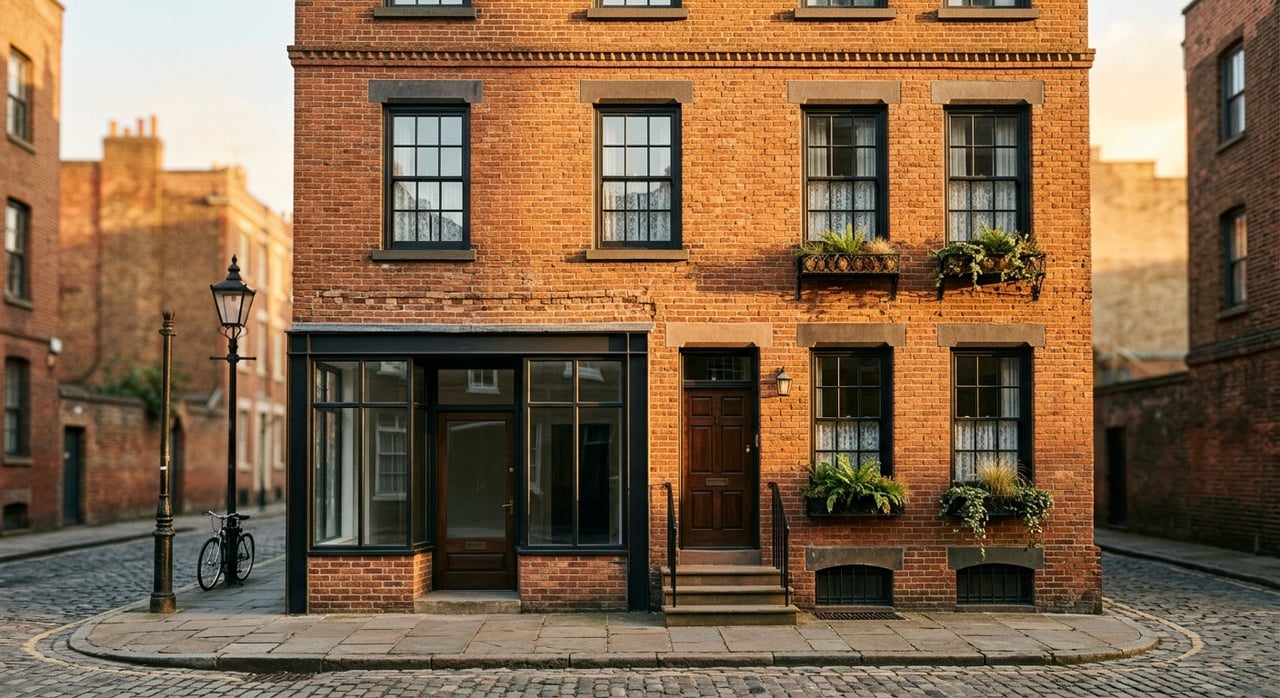
In Falls Church, a small mixed-use investment is usually an infill or redevelopment play rather than a blank-slate land opportunity. In plain terms, you are more likely to be evaluating a corner parcel, an assembled site, or an underused commercial property than a large open tract.
The city’s planning and zoning framework supports this pattern. Its comprehensive plan and small area plans for places like North Washington Street, South Washington Street, the Downtown Opportunity Area, and West Broad Street all point toward corridor redevelopment, mixed-use projects, and a balance between commercial activity and neighborhood preservation.
That does not mean every parcel is ready for an easy project. It means the city has already signaled that mixed-use is part of its long-term vision, especially along key commercial corridors.
One of the most relevant local tools is the city’s T-zone framework. Falls Church says these transition areas sit between commercial districts and single-family neighborhoods, cover about 24 acres or less than 3 percent of the city, and were updated to help small infill residential projects move forward on sites that are too small for large mixed-use or commercial development, while still allowing more neighborhood-serving retail.
For investors, that matters because it shows the city is not focused only on major headline projects. It is also trying to create a path for more modest infill opportunities where scale, parking, and neighborhood context matter.
The city’s mixed-use framework also includes the MUR overlay, which is intended to promote parcel consolidation and integrated redevelopment instead of piecemeal single-use construction. That makes assembled or strategically positioned sites more interesting than standalone properties that cannot solve for access, parking, or coordinated design.
Falls Church’s current and recent pipeline makes mixed-use feel very real, not theoretical. City project pages describe developments such as Founders Row, One City Center, Modera Falls Church, the Rushmark and Harris Teeter project, and the Maple and Annandale mixed-use proposal.
These are not all “small” in the way an individual investor might define the term, but they are useful examples of local direction. They show a pattern of vertical mixed-use, structured parking, and retail paired with apartments on sites that are still relatively constrained compared with many suburban projects.
Here are a few examples from the city’s project descriptions:
| Project | Key Features |
|---|---|
| Modera Falls Church | 280 rental apartments, 22,146 square feet of ground-floor retail, underground parking |
| Maple and Annandale | 195 rental units, 14,470 square feet of commercial space, underground parking |
| Founders Row | Retail, 800-seat movie theater, 322 rental apartments, 72 age-restricted apartments |
| Rushmark and Harris Teeter | 60,000-square-foot grocery store, 3,470 square feet of other retail, 282 apartments, underground parking |
| One City Center | Proposed 10-story mixed-use project with about 109,912 square feet of commercial space and 246 rental apartments |
The takeaway is not that a small investor should chase projects at this scale. The takeaway is that the city has established a clear pattern: mixed-use with practical retail and housing above is a recognized local product type.
In many markets, buyers get excited about restaurant-heavy or destination-style retail. In Falls Church, the stronger fit often appears to be neighborhood-serving space.
City project materials reinforce that point. Modera’s retail is described as oriented toward day-to-day convenience services, and the Rushmark project is anchored by a grocery component.
That matters because a small building usually needs retail that can serve nearby residents consistently. Convenience-oriented tenants may be more aligned with the local planning direction and day-to-day demand than uses that depend on a broader destination draw.
With small mixed-use, the retail portion often needs the most scrutiny. Residential units may bring steadier month-to-month occupancy patterns, while the street-level commercial suite can create more variability in leasing, rollover, and operating costs.
Lease structure matters here. In commercial real estate, net leases typically shift property taxes, insurance, and maintenance costs to the tenant, while gross or modified-gross leases leave more of those expenses with the owner. In multi-tenant buildings, common area maintenance charges are often used to recover shared operating costs.
For you as an investor, the core question is simple: how much expense recovery does the retail lease actually provide? If the answer is limited, the income may need to be underwritten more conservatively.
In a compact city, small details can have a big impact on returns. Parking is one of the clearest examples.
Falls Church’s parking rules require that a mixed-use property and any shared parking facility either be under common ownership or covered by a recorded shared-parking agreement that runs with the land. On a tight site, that can shape everything from design feasibility to lender comfort and long-term operational flexibility.
Business operations also have local requirements. The city requires most businesses to register and obtain a business license each year, with new businesses applying within 30 days of opening. The city also levies a business tangible personal property tax on business equipment, and that tax is not prorated.
If your project includes residential units, there may be another layer to review. The city’s affordable dwelling unit program may apply to residential development in MUR-designated areas and some mixed-use districts, so your underwriting should allow for possible compliance costs or concessions.
Small mixed-use investments are not usually financed like a standard residential property. The underwriting is more about rent roll quality, tenant durability, lease rollover, parking, reserves, and how realistic the operating assumptions are.
There is also an important difference between owner-occupied and pure investment scenarios. SBA financing can sometimes work for owner-occupied mixed-use assets. SBA 7(a) loans may be used to acquire, refinance, or improve real estate and buildings, while SBA 504 loans provide long-term fixed-rate financing for major fixed assets, with a maximum of $5.5 million.
But there is a key limitation. SBA 504 eligibility requires the operating company to occupy at least 51 percent of the rentable property, and the program is not intended for speculation or investment in rental real estate. So if you are buying a building primarily as a leased investment, you should expect underwriting to depend more heavily on the property’s income profile and risk factors.
In a market like Falls Church, taxes can materially affect returns. The city lists the FY2026 real estate tax rate at $1.185 per $100 of assessed value, and the FY2027 proposed budget keeps that rate at the same level.
That may sound straightforward, but the impact adds up quickly in a market where property values are high. If you are modeling a mixed-use acquisition, taxes should be treated as a meaningful operating item, not a footnote.
Falls Church’s demand story is tied closely to regional access. The city sits inside the Beltway and near major employment centers, and its planning documents note that Metro access, including the Silver Line’s broader impact, has supported growth and development.
That regional connectivity helps explain why mixed-use keeps showing up in the city’s pipeline. Housing near services, transit, and established corridors fits both the local policy direction and the practical needs of people who want convenience in a compact location.
For smaller investors, this is encouraging because it supports the idea that well-located infill can have staying power. But it does not eliminate the need for discipline around site selection, parking, entitlements, and lease structure.
If you are evaluating a small mixed-use opportunity in Falls Church, it helps to simplify your review into a few major questions:
Those questions can quickly tell you whether a property is practical or just interesting on paper.
Small mixed-use investments in Falls Church can make sense, but they are usually not passive, plug-and-play deals. This is a compact, transit-accessible, high-value market where local planning supports redevelopment, yet site constraints and public-review realities still matter.
In many cases, the best opportunities are likely to be disciplined infill projects with neighborhood-serving retail on the ground floor and housing above. If you approach Falls Church with realistic underwriting and strong local guidance, you can better separate durable opportunities from properties that only look promising at first glance.
If you are weighing a mixed-use purchase, redevelopment site, or small commercial opportunity in Falls Church, Taylor J Barnes can help you evaluate the local market, property fit, and transaction strategy with the kind of hands-on guidance that comes from deep Northern Virginia experience.
Stay up to date on the latest real estate trends.



Get assistance in determining current property value, crafting a competitive offer, writing and negotiating a contract, and much more. Contact me today.